
2026 Q1 Asia Fair Trial Practices Roundtable on Effective Participation in Criminal Proceedings for Persons with Disabilities
Across Asia, legal frameworks increasingly recognize the rights of persons with disabilities to effective participation in criminal proceedings. Yet a misalignment remains between formal legal measures and meaningful implementation. In practice, disability accommodations are often driven by individual effort rather than systemic support, making lawyers and advocates essential in closing that gap and ensuring effective participation.
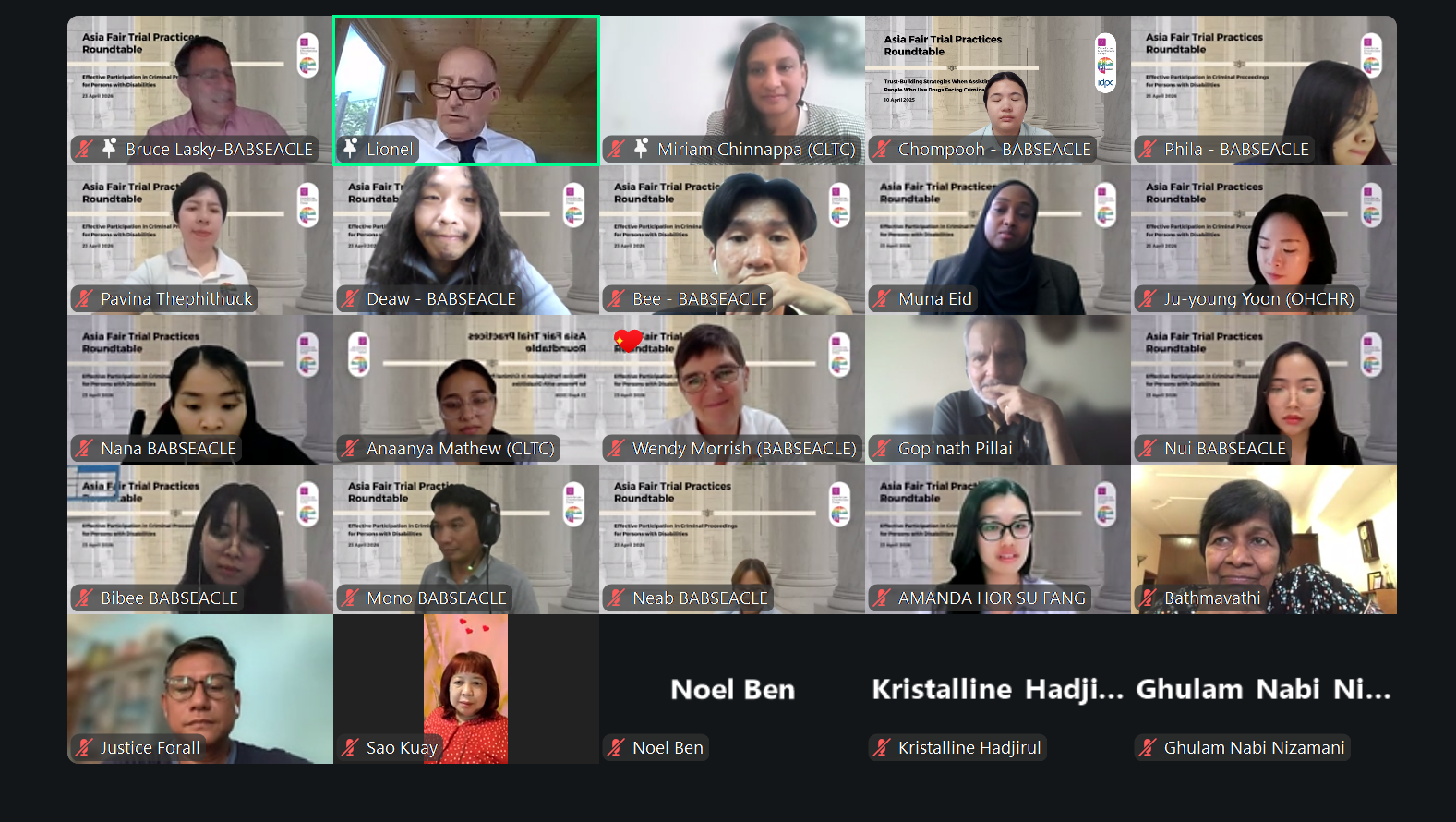
The First-quarter 2026 Asia Fair Trial Practices Roundtable was jointly organized by BABSEACLE and the Centre for Law and Transformative Change (CLTC) on Thursday, April 23, 2026, to bring together practitioners, civil society actors, and persons from affected communities to exchange litigation-focused experiences and strategies for advancing effective participation of persons with disabilities in criminal proceedings. The online roundtable was attended by more than 60 participants from diverse jurisdictions.
The roundtable opened with a keynote address delivered by Peggy Yee, Founding Director of PY Legal LLC, who has advocated for persons with invisible disabilities for over 20 years. In her speech, Ms Yee shared her personal and professional advocacy work, as well as Singapore’s progress in enhancing access to justice for persons with invisible disabilities, calling on everyone to look further when assessing disability and to promote justice for those with invisible disabilities in every country, every culture, and every justice system.
Moderated by Miriam Chinnappa, Executive Director and Co-founder of CLTC, the roundtable discussion examined the role of intermediaries in assisting communication for persons with disabilities within the criminal legal system, as well as the gap between normative frameworks, institutions, and processes, which is critical for legal practitioners to employ strategies to advocate for persons with disabilities through early counsel access and holistic networking to ensure that persons with disabilities can fully participate in legal proceedings.
The discussion further underscored how important the checklist for legal practitioners is when working with persons with disabilities in contact with the criminal justice system, in line with the Convention on the Rights of Persons with Disabilities (CRPD), to provide reasonable accommodation to persons with disabilities on an equal basis with others. A presenter from the United Kingdom said, “It makes a real difference in how well someone can engage and communicate and ask what they would like support in. When they are having a trial and evidence has been presented against them, and they may not understand the legal language in it, being able to participate meaningfully is really important. Making sure that they’ve understood exactly what evidence was presented and what they want to add to it are really important things in ensuring that your client and the person that you are supporting, or you know that you are representing, is basically communicate. You are able to participate every step of the way. That is essential.”
Reinforcing domestic advocacy requires cohesive, multi-stakeholder engagement among civil society sectors, organizations of persons with disabilities, government bodies, and UN entities to navigate the human rights mechanisms protecting persons with disabilities and drive positive systemic change. This includes ensuring reasonable accommodations and meaningful participation in court proceedings for every criminal case involving a person with a disability, thereby safeguarding effective and equal access to justice for disabled people.