Clinical Legal Education
Learning through ethical practice. Strengthening justice.
What is Clinical Legal Education (CLE)?
An educational program that uses an interactive and reflective teaching method to give law students the knowledge, skills and values they need to deliver legal services and advance social justice.
Read more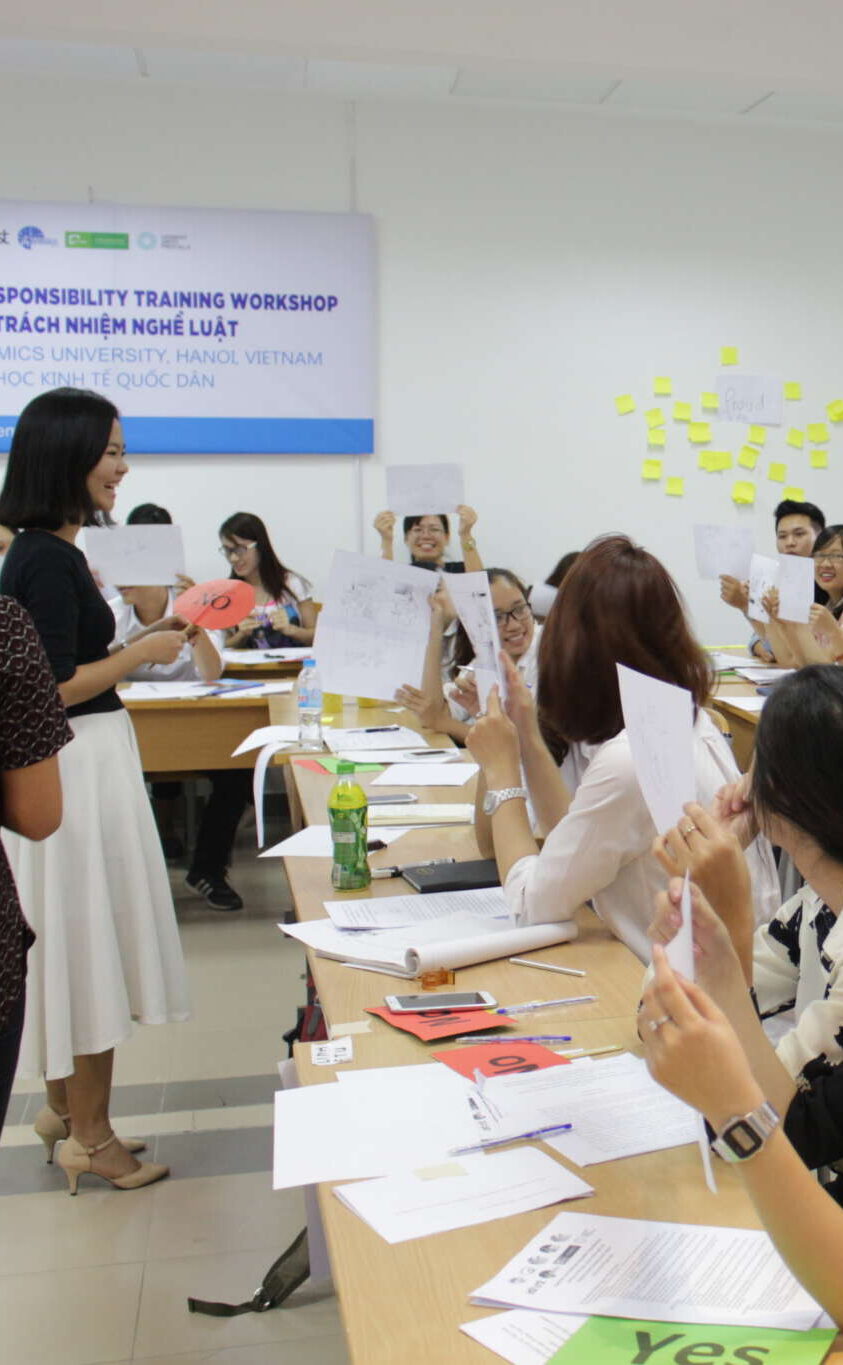
BABSEACLE’s approach to strengthening legal education, access to justice, and ethical legal practice.
Key elements of CLE
CLE is an educational program
A structured part of legal education, not an add-on to it.
CLE uses interactive and reflective methodology
Students learn by doing, then step back to examine what they did.
CLE provides practical knowledge, legal skills and legal values
The foundation for delivering legal services and social justice.
6 Goals of CLE
The Six Goals of Clinical Legal Education guide BABSEACLE’s approach to developing effective and sustainable CLE programs. They connect practical learning, access to justice, professional ethics, community engagement, and interactive teaching. By embedding these goals into legal education and the regular operation of CLE programs, CLE methods become normalized. Over time, this supports their institutionalization within universities and justice institutions, helping CLE programs become locally led, lasting, and sustainable.
Select a segment of the wheel to read each goal.
Law Students
CLE Goal 1 strengthens law students by providing a structured educational opportunity allowing them to learn and apply knowledge, legal skills and values from real-life legal experiences.
CLE in Practice
CLE in Practice shows how BABSEACLE’s contextualized and experiential methodology is applied through interconnected themes, including university partnerships, curriculum and materials development, community teaching, clinics and externships, legal ethics, capacity strengthening, assessment and regional collaboration. Together, these themes support the repeated use of CLE programmes and methods, contributing to their normalization, institutionalization and long-term sustainability.
BABSEACLE’s Clinical Legal Education Initiative: From Cambodia to a Regional and Global Movement
Beginning in Cambodia in 2003, BABSEACLE’s Clinical Legal Education Initiative has supported the development of practical, ethical and community-focused legal education. What began through work with one university developed into long-term partnerships, national university networks and regional collaboration across Asia.
The history below primarily traces BABSEACLE’s CLE journey across Asia. It is also important to recognize that BABSEACLE’s work and methodology have extended beyond the region and have been shared, adapted and replicated globally through university partnerships, professional networks, conferences, training programs and cross-border peer learning.
The timeline shows how BABSEACLE has worked with universities, justice institutions, legal professionals and communities to support the normalization, institutionalization, and sustainability of CLE programs and methods. The 2005 Southeast Asia CLE Conference is included as an important regional milestone that helped shape the wider environment in which BABSEACLE’s CLE Initiative developed.
- 2003
The Beginning in Cambodia
BABSEACLE’s CLE journey began in Cambodia in 2003 through work with Paññāsāstra University of Cambodia. This early partnership connected interactive legal education with community teaching, enabling law students to apply their learning while helping communities understand the law.
- Nov 2005
The First Southeast Asia CLE Conference
The first Southeast Asia Clinical Legal Education Conference was held in Phnom Penh, Cambodia, from 26–30 November 2005. It brought together approximately 85 participants from universities and civil society organisations, representing more than 16 countries.
Participants were introduced to different CLE experiences and approaches from countries including Mongolia, China, South Africa, Bangladesh, the Philippines and Cambodia. They explored university clinic models, interactive teaching, community legal education, access to justice and the role of law students in supporting communities.
The conference helped participants build regional relationships, compare different approaches and identify opportunities for university clinic development, teacher training and continued cooperation. These connections contributed to the regional learning and university partnerships that expanded during the following years.
- 2006–2008
CLE Partnerships Expand Across Southeast Asia
Between 2006 and 2008, BABSEACLE’s work expanded from Cambodia to Malaysia, Thailand, Lao PDR, Vietnam and the Philippines. Early partnerships included universities in Malaysia and Thailand, while new relationships were developed with universities in Lao PDR, Vietnam and the Philippines.
In 2007, BABSEACLE reported delivering CLE training across six countries. The launch of a CLE programme at the National University of Laos and the development of Malaysia’s first accredited university-based CLE course in 2008 demonstrated that CLE was beginning to move from introductory activities into formal university programmes.
- 2009–2012
National University Networks Begin to Form
From 2009, the work increasingly focused on building national CLE networks rather than supporting isolated university programs.
In Vietnam, BABSEACLE worked with more than seven universities in 2009. By 2010, the network included 10 CLE partners, and the 2010–2011 national research involved 8 core university partners and 7 additional partners.
In Thailand, CLE programs and accredited courses expanded through a growing national university network. A 2011 workshop involved representatives from 7 universities, while a 2012 national workshop brought together representatives from more than 20 Thai law faculties.
During the same period, university partnerships and peer exchanges connected programs in Cambodia, Indonesia, Lao PDR, Malaysia, Singapore, Thailand and Vietnam.
- 2013–2016
Nationwide CLE Development in Myanmar
BABSEACLE began supporting CLE development in Myanmar in 2013. Initial engagement at Yangon University grew into a coordinated national initiative involving all 18 university law departments.
By April 2014, all 18 departments had agreed to use interactive CLE methods within legal education. During 2014, universities formalized their participation and strengthened teacher development, curriculum integration and different CLE programme models.
By 2015, all 18 university law faculties were participating in national activities and developing their own CLE programmes. Universities implemented community teaching, in-house consultation clinics, externships and mock trials according to their local capacity and context.
- 2013–2015
University Networks Deepen in Vietnam, Thailand and Lao PDR
Alongside the expansion in Myanmar, established CLE networks continued to develop elsewhere.
In Vietnam, a nine-member university CLE network reviewed five years of development in 2014. Five university CLE programmes subsequently delivered and assessed community legal education activities across five provinces.
In Lao PDR, BABSEACLE’s work expanded beyond the Faculty of Law & Political Science at the National University of Laos to include the Faculty of Law & Administration at Champasak University, creating a documented network of two higher-education institutions by 2014.
In Thailand, universities continued to develop CLE courses, clinics, community teaching programmes and national opportunities for lecturers and students to share their experience.
- 2015–2016
Regional CLE Learning Becomes More Structured
Regional CLE summer schools, conferences, workshops and university exchanges increasingly connected national CLE movements. Participants from Australia, Cambodia, China, Indonesia, Lao PDR, Malaysia, Mongolia, Myanmar, Nepal, Thailand, USA, and Vietnam, together with partners from outside the region, shared CLE models and teaching methods.
These exchanges enabled experienced universities and teachers to support newer programmes. Regional learning therefore became an important part of developing local leadership and reducing dependence on external trainers.
- 2016–2018
CLE Development Begins in the Maldives
In 2016, BABSEACLE assessed the potential for CLE development in the Maldives. The assessment examined three higher-education institutions—Maldives National University, Villa College and the Islamic University of Maldives—as well as one Maldives National University regional campus.
By 2017, Maldives National University had begun putting CLE into practice through a mandatory student externship, mock trials, moot courts, legislative drafting and accredited experiential learning.
- 2017–2019
CLE Becomes More Closely Connected to Communities
In Lao PDR, university CLE programmes at the National University of Laos and Champasak University connected student learning with community teaching, legal consultation and locally relevant curriculum development. Students and teachers delivered supervised legal education in communities while strengthening links with legal professionals and justice institutions.
This period demonstrated how CLE could simultaneously support student learning, university-community partnerships and greater access to understandable legal information.
- 2019–2026
CLE Connects Universities and Justice Institutions
From 2019 onward, BABSEACLE’s work in Lao PDR increasingly connected CLE with the National Institute of Justice campus network and provincial and district justice institutions.
CLE developed through a repeated cycle of preparation, interactive learning, community teaching, supervised externships, reflection and program improvement. By 2025–2026, this approach linked CLE centres and justice-sector placements in Vientiane, Luang Prabang, Savannakhet and Champasak, with additional community and legal-aid activities in Khammouane.
This represented an important stage in the normalization and institutionalization of CLE: local teachers, supervisors and justice personnel increasingly led the programs, while students gained structured opportunities to learn through practice.
From One University to Connected CLE Movements
Beginning with one university partnership in Cambodia in 2003, BABSEACLE’s work helped CLE emerge across multiple countries and educational systems. The process did not follow one fixed model. Each university and country adapted CLE to its own legal system, curriculum, language, institutional capacity and community needs.
Across the documented history, the work progressed through a recognizable pathway:
- Individual university partnerships
- National university networks
- Regional peer learning
- Locally led and institutionalized CLE programs
The university figures above relate to the specific years and initiatives in which they were reported. They should not be added together as a cumulative total because some universities participated across multiple years and initiatives.